
Starting line and finishing line are not the same
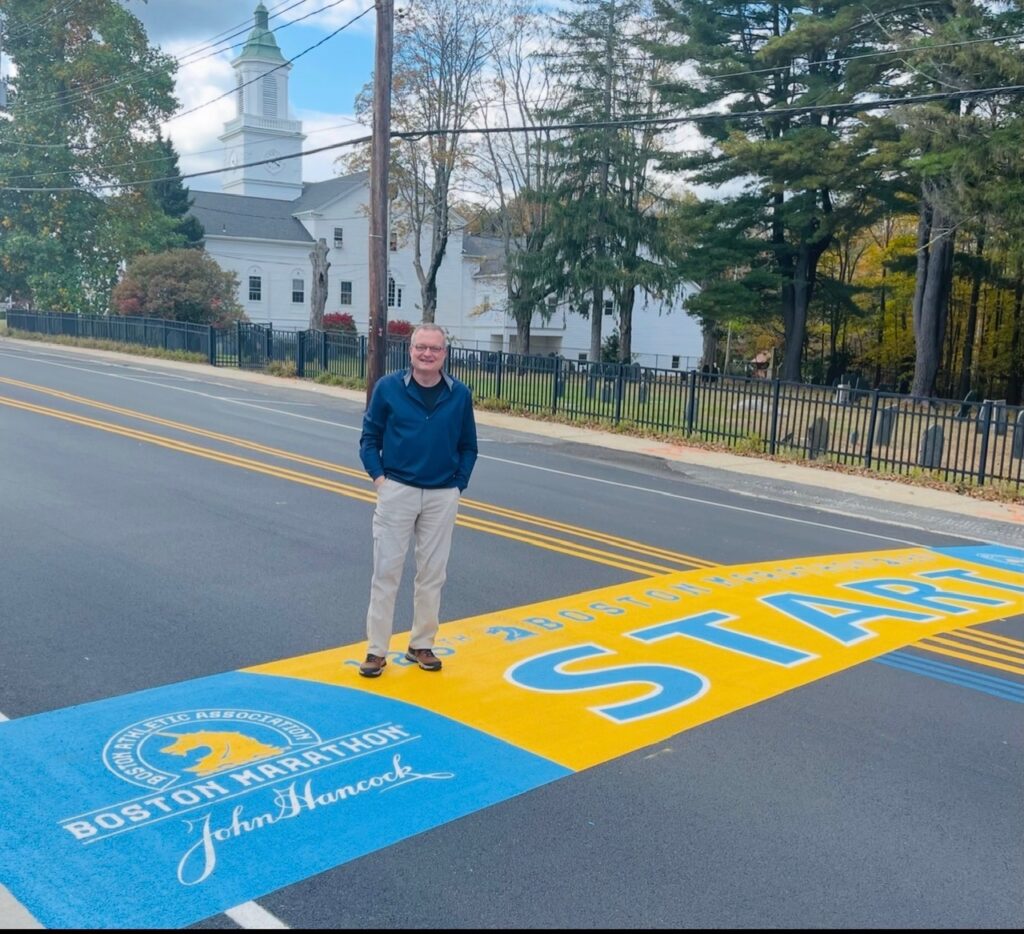
Several years ago, I was in the Boston area to teach the Go and Tell Evangelism Workshop and to preach at Fairlawn CRC. I flew into Logan Airport and was happy to meet my church contact, Brandon. We had a great lunch together and talked about the Boston area. As we were driving to the church, he told me that we were near the starting line of the Boston Marathon and asked me if I wanted to see it. I told him I would love to visit this famous landmark. I was excited to stand on the starting line of the world’s oldest and best-known marathon. As I stood on the line, I thought of the passage in 1 Corinthians 9:24-27: “Don’t you know that those who run in a race all run, but one receives the prize? Run like that, that you may win. Every man who strives in the games exercises self-control in all things. Now they do it to receive a corruptible crown, but we are incorruptible. I therefore run like that, not aimlessly. I fight like that, not beating the air, but I beat my body and bring it into submission, lest by any means, after I have preached to others, I myself should be rejected.“ Brandon told me he had run the race five times and talked about the training, hard work, and joy of completing it. The Boston Marathon usually takes place in the spring, on Patriots Day. Due to COVID, the race was held in the fall that year. I shared that I had a friend who ran in the Boston Marathon just a week ago. I shared how proud I was of this former college student who attended my church and ran track. I told him that Felicia is now a kinder- garten teacher in Michigan. When she ran the Boston Marathon, I followed along with her race progress on the official website, where you can write an encouraging note to the runners. I was blessed to read the messages from her students and school staff: “We are so proud of you! You are amazing! You’re doing great! Keep going—we are watching!” After the race, Felicia shared how awesome it was to receive so much support and encouragement that spurred her on to finish. I thought of the passage in Hebrews 12:1, which says, “Therefore, since we are surrounded by such a great cloud of witnesses, let us throw off everything that hinders and the sin that so easily entangles, and let us run with perseverance the race marked out for us.” I was able to stand on the Boston Marathon finish line the following day. As I reflected on standing on the starting and finishing lines of this great race, I realized something. One of the problems in the church today is that when people profess faith in Jesus, they think that the starting line and the finish line are the same spots. When we profess faith in Jesus, we begin to run the race for God’s glory. I think many Christians think that their salvation date is also the finish line. They believe they are saved, and eternal life is secure, but they neglect to run the race that is marked out for them for the glory of God. They live life in the way they want, but that’s not the race the Lord has for us. We are to live for the glory of God, and we are to run this race for Jesus. After we profess faith in Jesus, we are to live our lives for the glory of God. The Boston Marathon is exactly 26 miles and 386 yards, but we do not know how long our race for Jesus will be. It might be a race of a year, five years, 10 years, or 50 years, but we have a race marked out before us. The Scriptures tell us that there are going to be people who will try to discourage us from running this race. Galatians 5:7-8 says, “You were running a good race. Who cut in on you and kept you from obeying the truth? That kind of persuasion does not come from the one who calls you.” The Bible warns us that people will seek to hinder us from running the race and get us off the course that the Lord has for us. I just read a heartbreaking story about being led off the racecourse at the Quad Cities Marathon in Moline, Illinois, recently. The two marathon front-runners were about halfway to the finish line when they spotted a marathon volunteer cycling through the route. They both followed the volunteer, who mistakenly led both runners off the course. They were both automatically disqualified from the race, which is also a Boston Marathon qualifier event. I want to ask you: is anyone seeking to dissuade you from running the race the Lord has marked out for you? Are people discouraging you from reading the word of God, praying for others, praying for the lost by name, sharing the love of Jesus by your deeds and words, or discouraging you from meeting with other believers? The Bible warns us that the enemy will seek to keep us from finishing this race. Over the years, I have seen many people be led off the Lord’s course laid out for them. Are you running the race the Lord has for you, or has someone led you astray? I do not know how long I must run this race of life for the glory of God, but I do know that I want to finish the race well. As Felicia ran the Boston Marathon for the first time, her friends, students, and family encouraged her to complete the race. She said it was very difficult, but she rejoiced that she completed the race and was so grateful for the support she received from others. I want to encourage you to stay on course and keep your eyes fixed
No More Excuses: What the Parable of the Great Banquet Teaches Us About Following Jesus

Have you ever felt like you want to follow Jesus more closely, but something always seems to get in the way? The truth is, many of us live with good intentions but delayed obedience. In Luke 14, Jesus tells a powerful story – the Parable of the Great Banquet – that challenges our excuses and calls us into deeper commitment. This message isn’t just for a quiet devotional moment. It’s a direct invitation to examine our priorities and respond to God’s call in our everyday lives. The Parable of the Great Banquet: God’s Invitation Is Ready In Luke 14:16 – 17 (NIV), Jesus describes a man preparing a great banquet: “A certain man was preparing a great banquet and invited many guests. At the time of the banquet, he sent his servant to tell those who had been invited, ‘Come, for everything is now ready.’” Picture it: the table is set, everything is prepared, and the invitation has already been sent. All that’s left is for the guests to come. This banquet represents God’s kingdom: His grace, His presence, and the life He offers through Jesus. The invitation is not partial or delayed. It’s ready now. “They All Began to Make Excuses” Instead of accepting the invitation, the guests respond with excuses (Luke 14:18–20): While these may sound reasonable, they all point to the same issue: something else took priority over responding to the invitation. Today, our excuses may look different, but the heart behind them is the same: None of these are inherently wrong, but when they consistently come before Jesus, they become barriers to spiritual growth. Why We Make Excuses in Our Faith Journey Following Jesus requires surrender. It asks us to: That’s not always easy. Often, excuses are less about time and more about reluctance to fully trust God. We delay obedience because it feels safer to stay where we are. But Jesus makes it clear: the invitation isn’t something to postpone, it’s something to respond to. The Cost of Discipleship: Carry Your Cross Right after the parable, Jesus gives a sobering challenge in Luke 14:26 – 27: “And whoever does not carry their cross and follow me cannot be my disciple.” This doesn’t mean rejecting loved ones, it means putting Jesus first above everything else. True discipleship involves: It’s a call to wholehearted commitment – not casual belief. How to Stop Making Excuses and Start Following Jesus If you’re ready to move from intention to action, here are some practical steps: 1. Identify Your Excuses Be honest with yourself. What’s been holding you back from fully saying “yes” to Jesus? 2. Surrender Your Plans Proverbs 16:3 reminds us: “Commit to the Lord whatever you do, and he will establish your plans.” God isn’t asking for perfection. He’s asking for willingness. 3. Delight in Your Relationship with Jesus Faith isn’t just about responsibility, it’s about relationship. The more time you spend with Jesus, the more your desires begin to align with His. 4. Share the Invitation The servants in the parable were sent to invite others. We are called to do the same through conversations, kindness, and sharing our story. 5. Invest in Others Following Jesus isn’t meant to be done alone. Walk alongside others, encourage them, and grow together in faith. A Clear Call: The Invitation Still Stands The message of the Great Banquet is simple but urgent: God’s invitation is ready – but it requires a response. We can keep making excuses, or we can step into the life Jesus is calling us to live. Not later. Not when things settle down.Now. Reflection: What Is Holding You Back? Take a moment to pause and reflect: Write your answers down, pray through them personally, or share them with a trusted friend. The banquet is ready. The invitation is personal. Will you respond – or make another excuse?
The One Thing Every Church Leader Needs to Ignite Multiplication

You’ve prayed for growth. You’ve preached the Great Commission. You’ve cast vision for evangelism and discipleship. Yet deep down, many pastors and church leaders wrestle with the same question: Why does our church experience addition… but not multiplication? The answer isn’t more programs.It isn’t good marketing.It isn’t even more passionate preaching. The breakthrough lies in one foundational shift: An intentional, systematic approach to equipping every believer as a disciple-maker. When churches recover this biblical model, multiplication becomes not just possible -but inevitable. The Multiplication Gap: Why Most Churches Plateau Look at the typical church calendar: Each creates a burst of excitement. Some participate. A few new people join. But over time, the same core group carries the weight while most remain spectators in their spiritual journey. This is the difference between addition and multiplication. Addition Model In an addition model: Multiplication Model In a multiplication model: The Great Commission doesn’t say “make converts.” It says to make disciples – teaching them to obey everything Jesus commanded, which includes making more disciples. Multiplication is built into authentic discipleship. So why don’t more churches experience it? Because inspiration without implementation creates guilt, not growth. People hear powerful sermons about evangelism. They feel stirred. But without practical training and structured support, they don’t know what to do next. Shifting Church Culture: From Passive to Active Evangelism Multiplication requires more than motivation. It requires culture change. Instead of organizing your church around attendance and events, organize it around developing disciple-makers. Instead of measuring success by how many people show up, measure it by how many people are actively making disciples. This cultural shift affects everything: But here’s the key insight: Culture doesn’t change through announcements. It changes through systems. If you want multiplication, you must build processes that: When this happens, evangelism becomes a lifestyle—not just a church event. The Biblical Foundation for Multiplication Multiplication is not a modern church growth strategy. It is the apostolic pattern. In Ephesians 4, Paul explains that leaders exist to equip the saints for the work of ministry. That means ministry isn’t reserved for professionals. Every believer is called and equipped. Jesus modeled this perfectly. Rather than trying to reach everyone personally, He invested deeply in twelve disciples. Those twelve multiplied His ministry across the known world. The early church understood this instinctively. Every believer saw themselves as a missionary in their everyday context. Contrast that with consumer Christianity today: Biblical Christianity looks different: Multiplication begins when believers stop consuming and start participating. The Compounding Power of Disciples Making Disciples Multiplication follows exponential growth. If one believer leads one person to Christ each year – and each new believer does the same – the growth curve quickly becomes remarkable. But multiplication isn’t just about numbers. It’s about: Event-based evangelism creates spikes of activity.Systematic disciple-making creates sustained growth. When people experience the joy of leading someone to faith and walking with them in discipleship, enthusiasm spreads. Stories multiply. Mission becomes contagious. But this only works if the process is simple and reproducible. If disciple-making depends on a pastor’s charisma, it won’t scale.If evangelism requires professional training, most won’t try. Multiplication thrives on clarity and simplicity. Evaluating Your Church’s Evangelism Effectiveness Before building new systems, evaluate your current reality. Ask honest questions: Many churches have strong systems for attendance – but weak systems for multiplication. This isn’t a failure of passion. It’s often a structural blind spot. Clarity leads to action. When you identify the gap between biblical calling and current practice, you can build bridges through intentional disciple-making systems. From Vision to Implementation Knowing multiplication is biblical isn’t enough. You need a plan. Here’s a practical path forward: 1. Start with a Core Team Identify faithful, teachable believers with a heart for evangelism. Train them intentionally. 2. Build Reproducible Frameworks Create simple processes anyone can learn and teach. Avoid complexity. 3. Normalize Evangelism Share testimonies. Celebrate gospel conversations. Make disciple-making ordinary. 4. Subtract to Multiply Eliminate programs that drain energy but don’t produce disciple-makers. Multiplication often requires subtraction. When disciple-making becomes your organizing principle, everything changes. Your Next Step Toward Church Multiplication You stand at a crossroads. You can: Transformation doesn’t require perfection. It requires direction. Start with evaluation. Get clarity on your current disciple-making health. Identify gaps. Create intentional training pathways. Establish accountability structures. The world doesn’t need more church events.It needs churches that take disciple-making seriously. Multiplication isn’t mysterious. It begins with one decision: Equip every believer to make disciples. When that becomes your foundation, growth stops being something you try to manufacture – and starts becoming the natural outcome of obedience. The question isn’t whether multiplication is possible. The question is:Will you take the first step this week to make it inevitable?
The Word of God: Our Pillar of Fire and Daily Guide

Just as the pillar of fire never wavered in brightness, Scripture provides steady, reliable guidance. It does not merely suggest a direction; it goes before us, preparing the way. It brings clarity in confusion, wisdom in decision-making, and peace in seasons of uncertainty.
5 Church Toolbox Essentials for Consistent Gospel Impact

Every Sunday, pastors across the nation cast vision for reaching their communities with the gospel, but by Wednesday, that fire has faded into familiar routines. The gap between evangelistic aspiration and actual gospel conversations isn’t a passion problem—it’s a toolbox problem.
Prayer is the work of Evangelism
Please read and be blessed as I share my 46-year prayer journey for my sister’s salvation. https://network.crcna.org/topic/church-strategy-mission/evangelism/prayer-work-evangelism
What is your reason?
In the Ministry Today magazine, they recently had an article entitled 9 Reasons Christians Don’t Evangelize. Here are three of the nine reasons they listed: 1. We have few evangelistic role models.2. Some churches have provided no evangelism training.3. Pastors aren’t taking the lead in evangelism Those reasons are a good description of the evangelistic duties listed of a pastor in the CRC. (In the Manual of the CRC Government (article 12-a), it shares that one of the duties of pastors of congregations is to Engage in and promote evangelism. It states: Both the pastor and elders are called to participate in and promote evangelism, giving leadership as well as setting a zealous example for the congregation in the promotion of this work.). The Go and Tell Evangelism Workshop is one way to equip the pastors and elders to engage in and promote evangelism with their congregation and helps them to set a zealous example for their congregation. Go and Tell Evangelism Workshop is a three-hour seminar and is an easy and practical way to equip you to become a fisherman of men (Matthew 4:19) based on the Heidelberg Catechism. The Go and Tell Evangelism Workshop is a free online seminar and includes videos, audio, a booklet, and additional free resources. You can also schedule a Go & Tell Evangelism Workshop at your church. (See the link below.)Go and Tell Testimonial from Steven Van Zanen (Director for Missions Mobilization, Christian Reformed World Missions): “Many are concerned about the future of Christianity in America, and with good reason. The most important cure for what ails the Church is a renewed appreciation for the heart of the Gospel message and the ability to communicate that to others. The kind of training in evangelism offered by Go and Tell will not only enable people to witness to Jesus Christ effectively, it will deepen the faith of those trained and encourage them in their walk of faith.”
End-of-year gift to Go & Tell Ministries
As we end 2023 with all our expenses adequately cared for, we praise the Lord for how His faithful servants and churches have supported Go & Tell Ministries with their finances and prayers. Please prayerfully consider sending an end-of-the-year gift to Go & Tell Ministries (check or online), so we not only finish 2023 strong but enter into the coming year with great anticipation for all the Lord will do in 2024! He continues to provide opportunities for more significant impact and broader scope, and we trust Him for the resources to match that vision. “I have not stopped giving thanks for you, remembering you in my prayers.” Ephesians 1:16 https://www.paypal.com/donate/?hosted_button_id=YWL5JBEC34PR8
Go & Tell Evangelism Workshop Testimonial
I received this wonderful testimonial after I taught the Go & Tell Evangelism Workshop @ Hopkins Community Church. It is so encouraging to see churches begin to pray for the salvation of those that the Lord has placed in their life and to share the gospel of Jesus Christ. Praying that the Lord will continue to raise up workers for the harvest field via Go & Tell Ministries. “Good Monday Morning, Jim! I just wanted to share some experiences we’ve been having here at HCC! A little less than a month ago, after Sunday worship, we led a young man to Christ! Yesterday, we had three people share, as part of the sermon, their different experiences responding to the Holy Spirit’s prompting to talk with others about their faith! Two led people to Jesus; one discovered fellowship with someone he didn’t know was a believer! We are very excited to hear these things! We are pressing forward, believing these are just the first drops of an outpouring of the Kingdom of God here in Hopkins! May Grace and Peace be yours in abundance.” Pastor Jonathon VanderWall HOPKINS COMMUNITY CHURCH
On Mary Poppins and Finding our Song
As a child, one of my favorite movies was Mary Poppins. Mary Poppins is the most award-winning movie of all time and a timeless classic. The movie Saving Mr. Banks is about the making of Mary Poppins. Saving Mr. Banks focuses on P.L. Travers, author of the Mary Poppins children’s novel. It is the story of the author’s battles with Walt Disney, who wants the rights to a feature-length movie. Walt Disney said he decided many years ago to make Mary Poppins into a feature-length film. He promised his girls he would make a movie from P. L. Traver’s book! Walt Disney was desperate to bring the story to film, but the author was against giving Disney the rights to make a movie out of it. Why? Because a lot of the book comes from her life experiences growing up. She had a father she loved who was an alcoholic, as well as an aunt who came to help him. This helping aunt became Mary Poppins. The author had a complex family background. For over 20 years, Walt Disney pursued the rights to make the book into a movie, culminating with flying Travers to Los Angeles to begin working on the project. Saving Mr. Banks shows that many writers use personal stories from their life, stories that are part of them. It was hard for Travers, as she had invested so much in Mary Poppins, so much of herself in the story. The film slowly reveals how Traver’s childhood and her father became part of her writing and the themes of her books. In the same way, our lives become the stories in which we proclaim the daily testimony of how Jesus impacts our life. The power of our lives is found in understanding how Jesus impacts our lives daily for His glory. Our testimonies of Jesus not only greatly influence others for the Kingdom of God for His glory, but they also significantly affect overcoming the enemy. Revelation 12:11 says believers “triumphed over [Satan] by the blood of the Lamb and by the word of their testimony; they did not love their lives so much as to shrink from death.” Notice the “word” of their testimony, meaning these triumphant ones spoke verbally, without shame or fear. Some believe Christians should not verbalize their testimony but live it out daily. But it’s not an either-or proposition. Living the gospel message is essential, but it’s no more important than our verbal testimony since God has chosen “hearing” the Word to produce faith (Romans 10:17). A Christian who wants to live his life as a testimony to Jesus will love God above all else and love others above himself. When a believer shares what Jesus has done in his life and serves God and others in tangible ways, he will increasingly reflect the life-giving power of Christ into a dark and evil world. All believers are forgiven and redeemed by the blood of the Lamb (1 Peter 1:18–19). A believer’s testimony also assists in conquering the evil one, and he cannot defeat us if we resolutely confess our faith in Jesus. You are a living witness if you have experienced Jesus’ forgiveness and been born again. Are you enthusiastic about sharing the testimony of Jesus with those around you? As we would tell others about a doctor who cured a physical disease, we should speak about Christ, who forgives our sins and lives within us. And by the Word of their testimony – the faithful testimony they bore to the truth. They declared their belief in Jesus and shared how Jesus has changed—and is changing—their lives. It was by this that they overcame the great enemy. We are called to be like the man in the gospel of Mark who continually told others what the Lord has done and is doing in his life. In Mark 5:19-20 it says: “Jesus did not let him, but said, “Go home to your family and tell them how much the Lord has done for you, and how He has had mercy on you. So, the man went away and began to tell in the Decapolis how much Jesus had done for him. And all the people were amazed.” We overcome the enemy when we hold to the testimony of Jesus in our lives and share it with others. I was having lunch with some close friends after a Go & Tell Ministries weekend at a church in Indianapolis. We began to share the stories of Jesus in our lives when Jayna shared a word of her testimony with me. It was powerful and such an encouragement to me. Jayna shared this testimony with me: I was blessed to grow up in a Christian home and gave my life to Jesus when I was about 6 or 7. I am thankful that God gave me that opportunity so early in life, but through the years, I’ve felt like I didn’t have a powerful enough testimony to share how I came to faith in Jesus. Over the years, I have heard several people giving their testimonies of how God miraculously saved them from abuse, addictions, suicide, miraculous healings, etc. I thought their testimonies were so powerful because there was a sudden change in their lives that they and others could easily see. And as I listened, I secretly wished I had a testimony worth sharing, something powerful that would impact others and draw them to Christ so I could feel like my life meant something, like I had a purpose. Then almost as soon as I had that thought, I heard a gentle voice saying, “You know, you have to have a test to have a testimony.” Wow! I knew that wasn’t my thought and began to think maybe not having much of testimony was ok; as long as I was saved, perhaps it didn’t matter. I felt like I’d had enough hard things in life to at least be able to empathize with others, so maybe I could be used that way? Well, God had other plans! A few months or so later, Covid
The Saving Name of Jesus in a Jail Cell
I came home after a long day and was ready for a nice dinner with my wife (Kristi). She greeted me warmly and said dinner would be ready soon. I sat in my favorite recliner and turned on the local news broadcast. I suddenly sat up and sighed out loud, “Oh my!” Kristi heard my sigh from the kitchen and came in and asked what had happened. I just pointed to the television screen and said, “That was my former student, *Jeremy” (*name changed for confidentiality; I have his permission to share his story). The news broadcast showed his picture and told the sad story. A young man had been arrested for fatally striking a pedestrian with his car while she walked on a portion of the city-wide trail. After the news story ended, we joined hands and prayed for the victim’s family and for Jeremy. When I finished praying, Kristi looked up at me and said, “You are already planning to go to the jail to visit and share the gospel with him, aren’t you?” I nodded in affirmation and thought back to the last time I saw Jeremy. I have taught special education off and for 10 years (before, during, and in between pastoring several churches). I was Jeremy’s elementary special education teacher while he was in 2nd through 5th grade. I spent a lot of time with him, teaching him social skills, de-escalation strategies, and sharing this saying: “The choices I make are the choices that make me.” The last time I saw Jeremy was at the end of his 5th grade school year. His mother called me when he graduated high school to thank me for my impact on his life and to have Jeremy thank me. I remembered that I had prayed for him daily when I was his special education teacher. All those prayers and the compassion I had for this little boy, who was now a man, welled up in my heart. I thought of a passage of Scripture that talked of Jesus’ compassion for the multitude in Matthew 9:35-38, “Jesus went through all the towns and villages, teaching in their synagogues, preaching the good news of the kingdom, and healing every disease and sickness. When he saw the crowds, he had compassion on them because they were harassed and helpless, like sheep without a shepherd. Then he said to his disciples, “The harvest is plentiful, but the workers are few. Ask the Lord of the harvest, therefore, to send out workers into his harvest field.” When Jesus saw these multitudes, he was moved with compassion for them. Jesus saw the harassed and helpless people as sheep having no shepherd. The word “harassed” can also mean troubled, bewildered, or despondent. The word for “helpless” is also “prostrate” or “thrown to the ground.” The two words are near-synonyms that stress man’s helplessness without God. Jesus looked at the crowds following him and referred to them as a field ripe for harvest, but the laborers to bring in the harvest are few. Jesus commanded His disciples to pray to the Lord of the harvest to send out laborers. These laborers must warn people of coming judgment, call them to repentance, and place their faith in Jesus Christ. Many people are ready to give their lives to Christ if someone shows them how. We are to pray that people will respond to this need for workers. When we pray for something, God often answers our prayers by using us. I knew the Lord had prepared me to go and tell Jeremy the gospel of Jesus Christ. Since Covid, many local jails have canceled in-person visits and now only allow kiosk or Zoom visits. Our local jail had just begun to let clergy make in-person visits. I called and set up an appointment to meet Jeremy on a Friday afternoon. I walked into the jail and gave them my ID and personal belongings. The corrections staff led me back to the visitation wing. I sat and patiently waited in my glass portion cubicle to visit my former student (age 24), who I had not seen in over a decade. I sat down and wondered if he would even remember me. The guard escorted him into the room, and Jeremy stared at me for a few seconds. (He later told me he was expecting to see his Public Defender). He then had a big smile and said, “Mr. H, is that you?” I replied, “Hi Jeremy, yes, it is Mr. H. I have a few more gray hairs than the last time you saw me in elementary school.” We sat down and started to get reacquainted. I shared about my family, my ministry, and how I had retired from teaching a year ago. I heard his story of hardship and helplessness over the past several years since he graduated from high school. He had been working different temp jobs and struggling to make life work. He had several misdemeanors and other charges and was trying to get his life together when this tragedy happened. He was living in his car with his girlfriend at the time of the accident. Soon after, he found out his girlfriend was pregnant, and now he is a dad. I asked him about his church background, and he said he seldom attended. I asked him some spiritual questions, and we started talking about his situation and the gospel of Jesus. I asked him if he remembered the saying I had in my classroom when he was in elementary school. I started it by saying, “The choices I make…” and he finished it by saying, “…are the choices that make me.” I told him he could not change the past but could choose to change his future. I shared the gospel of Jesus Christ with him. I quoted Joshua 24:15, which says: “…then choose for yourselves this day whom you will serve… But as for me and my household, we will serve the LORD.” I asked him if he wanted to repent of his sins and choose
Go & Tell poem
I thought you would like this. I just received this poem from John Jackson…he attends my home church, Alliance Community Church. He wrote this poem for GO & TELL Ministries. It’s called Go & Tell. The world needs the FATHER, SON, and HOLY SPIRIT.How will they know unless they hear it?The Great Commission is for the Chosen.We were never called to be the Frozen!Millions everywhere need to be reached.The Gospel message must be preached.Only JESUS CHRIST can save the lost.Only HIS blood can cover the cost.It was never GOD’S will that any perish in Hell.We must stand up, step up…and Go & Tell!!!